
What’s the true miracle of Louis Zamperini’s survival?
Was it that his body endured forty-seven days adrift on a life raft in the Pacific Ocean, or was it that his mind survived the systematic, psychological assassination attempted in the POW camps of Japan?
Laura Hillenbrand’s acclaimed biography, Unbroken: A World War II Story of Survival, Resilience, and Redemption, is widely celebrated as an inspirational adventure. However, when viewed through a clinical lens, it’s a masterclass in human neurobiology, exploring the limits of executive function, the biological necessity of dignity, and the neuroplasticity of radical forgiveness.
We’ve meticulously curated and analyzed 44 Unbroken quotes with page numbers. Moving far beyond standard high-school summaries, we differentiate between Hillenbrand’s objective historical narration and the subjects’ internal dialogue. We apply frameworks of psychoneuroimmunology and trauma recovery to explain exactly how and why Zamperini survived.
Citation Methodology & Clinical Framework: Why trust this guide? We’ve hand-verified every quote below against the authoritative Random House Trade Paperbacks edition (July 29, 2014, ISBN-13: 978-0812974492). Our analysis uses clinical psychological frameworks, including Systemic Desensitization, Cognitive Anchoring, and Moral Injury, to explore the neurobiological reality of POW survival and Post-Traumatic Stress Disorder (C-PTSD). You can confidently cite these exact page numbers in your academic essays.
Quick Reference: The Most Searched Quotes with Page Numbers
What page is the “lifetime of glory” quote on in Unbroken?
The quote “A lifetime of glory is worth a moment of pain” is located on page 35 (Chapter 4).
What page is the “dignity” quote on in Unbroken?
The quote “Without dignity, identity is erased” is located on page 189 (Chapter 20). Note: Depending on the specific printing, this frequently spans pages 188-189.
What page is the “paradox of vengefulness” quote on in Unbroken?
The quote “The paradox of vengefulness is that it makes men dependent upon those who have harmed them…” is located on page 373 (Chapter 37).
What page is “if you can take it, you can make it” on in Unbroken?
This famous motivational mantra, spoken by Pete Zamperini to Louis, is located on page 35 (Chapter 4).
The Cognitive Architect: Early Life & Stress Inoculation
Louie Zamperini’s mischievous, often delinquent youth in Torrance, California, was eventually channeled into record-breaking speed on the track. However, this period of his life provided much more than athletic prowess. Guided by his older brother, Pete, Louis underwent a rigorous period of psychological conditioning.
From a clinical perspective, Pete acted as the “Cognitive Architect” of Louis’s survival. The punishing workouts and mental discipline required to become an Olympian functioned as early “Volitional Stress Inoculation,” training Zamperini’s nervous system to endure extreme physical discomfort without succumbing to autonomic panic. It was a biological shield he would desperately need in the years to come.
“It was not a great presence but a great absence, a geometric ocean of darkness that seemed to swallow heaven itself.”
(Narrator: Laura Hillenbrand, Chapter 1, Page 5)
Hillenbrand’s ominous description of the Graf Zeppelin casting a shadow over Louis’s childhood acts as a powerful narrative foreshadowing. It symbolizes the looming, inescapable darkness of global conflict that will eventually swallow the innocence of his youth. It frames his individual story against the massive, indifferent machinery of world history.
“His features, which would later settle into pleasant collaboration, was growing at different rates, giving him a curious face that seemed designed by committee.”
(Narrator: Laura Hillenbrand, Chapter 1, Page 8)
By focusing on the physical awkwardness of his early development, the narrator demythologizes the future war hero. This highlights that Zamperini wasn’t born a polished, indestructible icon; he was a fragmented, unruly child whose physical and psychological components had to be painfully forged together over time.
“Louie’s mother, Louise, took a different tack… Little Louise Zamperini, mother of four, was deep in the melee when the cops picked her up for brawling.”
(Narrator: Laura Hillenbrand, Chapter 1, Page 10)
This seemingly humorous anecdote provides crucial context for Louis’s innate defiance. The fierce, uncompromising survival instinct that allowed him to resist systemic dehumanization in the POW camps wasn’t merely learned; it was a deeply ingrained familial trait inherited directly from his fiercely protective mother.
“I have to go around with my shirt open so that I have enough room for my chest.”
(Speaker: Pete Zamperini, Chapter 3, Page 28)
Pete’s immense pride in his brother is the psychological anchor for Louis’s self-worth. By projecting such absolute, unshakeable confidence in Louis’s abilities, Pete effectively builds a reservoir of self-esteem in his brother. This strong ego structure becomes the psychological armor that camp guards will later find so difficult to penetrate.
“The buses drove to the Olympic stadium… As the birds circled in panicked confusion, cannons began firing, prompting the birds to relieve themselves over the athletes. With each report, the birds let fly. Louie stayed at attention, shaking with laughter.”
(Narrator: Laura Hillenbrand, Chapter 4, Page 33)
This absurd moment at the 1936 Berlin Olympics reveals a vital aspect of Zamperini’s psychological makeup: his capacity for autonomic regulation through humor. The ability to find dark comedy in a highly stressful, chaotic environment demonstrates a resilient nervous system capable of down-regulating panic, a coping mechanism that would later save his sanity.
“A lifetime of glory is worth a moment of pain. Louie thought: Let go.”
(Internal Monologue: Louis Zamperini, Chapter 4, Page 35)
TL;DR: This mantra is an executive control mechanism for delayed gratification, helping to override immediate pain signals.
Case 1.2: Delayed Gratification & Pain Modulation. This cognitive framework allows an individual to consciously prioritize a highly valued, abstract future goal over immediate, severe physical distress. In high-stress situations, this strong mental focus helps suppress acute pain signals by activating descending pathways in the brain that reduce the perception of physical discomfort.
By reframing acute suffering as a temporary obstacle, this mental discipline, drilled into him by his brother, helps sustain physical performance and endurance even when the body is near complete exhaustion.
The Crucible of the Pacific: Cognitive Anchoring on the Raft
Following the catastrophic crash of the Green Hornet, Louis Zamperini, Phil Phillips, and Mac McNamara found themselves adrift on the vast expanse of the Pacific Ocean. Their forty-seven days on the life rafts represent one of the most grueling tests of human endurance in recorded history, a battle against extreme starvation, complete dehydration, and the relentless, circling presence of sharks.
While most analyses frame this simply as a test of willpower, this period is best understood through the clinical lens of neurobiology. The conversations Louis and Phil shared, meticulously detailing recipes and childhood memories, weren’t merely ways to pass the time. They were vital acts of “cognitive anchoring.”
By forcing their brains to process complex semantic information, they preserved hippocampal pathways, actively staving off Wernicke’s encephalopathy (a severe cognitive decline caused by thiamine deficiency) and preventing the delirium-induced autonomic collapse that ultimately claimed their crewmate.
“ALL HE COULD SEE, IN EVERY DIRECTION, WAS WATER. It was June 23, 1943… Sharks glided in lazy loops around them, dragging their backs along the rafts, waiting.”
(Narrator: Laura Hillenbrand, Preface, Page xvii)
This ominous imagery establishes the ocean’s baseline biological threat. The sharks represent nature’s absolute, terrifying indifference, providing a backdrop of constant, passive lethality that continually triggers the men’s amygdalae, demanding a massive daily expenditure of neurological energy just to manage the sheer terror of their environment.
“People had long conversations with him, only to realize later that he hadn’t spoken.”
(Narrator: Laura Hillenbrand, Chapter 6, Page 60)
Hillenbrand’s description establishes Phil’s psychological baseline. His quiet introversion and deep, self-contained internal life are a the perfect foil to Louis’s fiery, defiant energy. This difference in neurobiological temperament creates a balanced cognitive ecosystem on the raft, where Phil’s quiet faith complements Louis’s active resistance.
“We just sat there and watched the plane pass the island, and it never came back,” he said. “I could see it on the radar. It makes you feel terrible. Life was cheap in war.”
(Speaker: Martin Cohn, Chapter 8, Page 87)
The ordnance officer’s blunt observation captures the profound psychological weight of helplessness experienced by those left behind. Watching a radar blip disappear translates the visceral horror of death into a cold, technological certainty, inflicting a unique type of secondary trauma on the surviving airmen.
“Life was cheap in war.”
(Narrator: Laura Hillenbrand, Chapter 8, Page 87)
By echoing Cohn’s sentiment in the narrative voice, Hillenbrand underscores the macro-level systemic dehumanization that occurs long before the men ever reach the POW camps. The military apparatus itself necessarily commodifies human life, laying the psychological groundwork for the severe moral injuries to come.
“Only the laundry knew how scared I was.”
(Speaker: Frank Rosynek, Chapter 8, Page 86)
This darkly humorous confession highlights the severe physiological manifestations of terror. It demonstrates how combatants are forced to suppress their natural autonomic fear responses (such as loss of bowel control during high-stress flight operations) to maintain the stoic social cohesion required by military culture.
“That night, before he tried to sleep, Louie prayed. He had prayed only once before in his life… That night on the raft, in words composed in his head, never passing his lips, he pleaded for help.”
(Narrator: Laura Hillenbrand, Chapter 13, Page 142)
This marks a critical psychological shift. When Zamperini’s executive function and physical capabilities reach their absolute biological limits, his reliance on pure self-determination fractures. The silent turn toward transcendental appeal is a profound coping mechanism, outsourcing the burden of survival to a higher power to prevent total mental collapse.
“If you dig into it, it comes back to you. That’s the way war is.”
(Speaker: Stanley Pillsbury, Chapter 13, Page 146)
Pillsbury articulates the clinical reality of intrusive traumatic memory encoding. The trauma of the Pacific Theater isn’t filed away as a standard narrative memory; it’s branded into the nervous system. Any attempt to “dig into it” bypasses conscious filters, causing the somatic experience of the war to flood vividly back into the present.
“some men may be wired for optimism, others for doubt.”
(Narrator: Laura Hillenbrand, Chapter 14, Page 154)
This observation touches upon modern psychobiology, suggesting that resilience isn’t purely a matter of moral character but is heavily influenced by innate neurological predispositions. It frames the men’s starkly different reactions on the raft as a matter of biological “wiring” in the face of catastrophic stress.
“Though all three men faced the same hardship, their differing perceptions of it appeared to be shaping their fates. Louie and Phil’s hope displaced their fear and inspired them to work toward their survival… Mac’s resignation seemed to paralyze him…”
(Narrator: Laura Hillenbrand, Chapter 14, Page 155)
TL;DR: An individual’s psychological framing of a crisis directly dictates their physiological ability to survive it.
Case 1.4: Learned Hopelessness vs. Optimism Bias. This passage perfectly illustrates the mind-body connection in extreme survival scenarios. Mac’s resignation triggers a rapid autonomic shutdown; his brain, perceiving inevitable death, stops signaling the body to fight, literally accelerating his physical decline. Conversely, Louis and Phil use “optimism bias” as a biological shield. By forcing themselves to believe in rescue, they keep their parasympathetic nervous systems engaged, allowing them to problem-solve and endure.
“If the sharks were going to try to eat him, he was going to try to eat them.”
(Internal Monologue: Louis Zamperini, Chapter 16, Page 168)
This is the ultimate assertion of somatosensory will. By deciding to attack the very apex predators hunting him, Zamperini performs a radical psychological reversal. Transforming his self-perception from helpless prey into an active predator reclaims his psychological capacity, completely short-circuiting the onset of learned helplessness.
“Such beauty, he thought, was too perfect to have come about by mere chance. That day in the center of the Pacific was, to him, a gift crafted deliberately, compassionately, for him and Phil.”
(Internal Monologue: Louis Zamperini, Chapter 16, Page 173)
TL;DR: Reframing sensory deprivation and isolation as a divine gift is a profound psychological buffer against existential despair.
Case 1.3: Cognitive Restructuring & Transcendence. Amidst severe starvation and isolation, Louis performs a radical neuroplastic reset. Instead of viewing the calm ocean as a vast, indifferent tomb, he actively reframes it as a compassionate, deliberate gift from a creator. This transcendental cognitive shift drastically down-regulates his amygdala’s panic response, converting raw existential dread into spiritual awe, which biochemically preserves his will to live.
“Louie found that the raft offered an unlikely intellectual refuge… his time unvaried and unbroken, his mind was freed of an encumbrance that civilization had imposed on it. In his head, he could roam anywhere, and he found that his mind was quick and clear, his imagination unfettered and supple.”
(Narrator: Laura Hillenbrand, Chapter 16, Pages 173-174)
TL;DR: Intense, focused mental visualization preserved critical brain functions against the severe neurodegeneration caused by starvation.
Case 1.1: Cognitive Anchoring & Executive Function. This is the clinical apex of their raft survival. By visualizing complex tasks and recalling hyper-detailed memories, Louis engaged in active “cognitive anchoring.” This rigorous mental stimulation forced blood flow to the prefrontal cortex and preserved critical hippocampal pathways. It actively staved off the severe delirium and neurological breakdown typically caused by thiamine deficiency, proving that intense intellectual exertion is a literal, biological survival mechanism.
Systemic Dehumanization: The Biological Threat of Identity Erasure
The transition from the life raft to the Japanese prisoner-of-war camps marks a terrifying shift in the nature of Louis Zamperini’s survival. While the ocean presented a crisis of severe physical deprivation, camps like Kwajalein, Omori, and Naoetsu were laboratories for targeted psychological torture. Orchestrated by sadistic guards, the abuse wasn’t merely punitive; it was a calculated manifestation of systemic dehumanization, exacerbated by a perversion of the Japanese military’s Bushido code, which viewed surrender as the ultimate disgrace.
Our analysis frames this captivity through the lens of psychoneuroimmunology. We examine how the unpredictable violence and relentless humiliation engineered by figures like Mutsuhiro “The Bird” Watanabe were designed to induce learned helplessness. In this clinical context, “dignity” isn’t a poetic concept; it’s an absolute biological necessity. The systematic stripping of self-worth is a lethal hazard, suppressing the immune system and erasing the victim’s psychological core.
“All I see, he thought, is a dead body breathing.”
(Internal Monologue: Louis Zamperini, Chapter 17, Page 182)
This devastating moment of self-reflection captures the profound somatic shock Zamperini experiences upon seeing his emaciated frame in Kwajalein. The cognitive dissonance of recognizing his own body as a corpse reveals the absolute physical devastation of the raft, while foreshadowing the psychological death the prison guards will soon attempt to inflict upon him.
“But on Kwajalein, the guards sought to deprive them of something that had sustained them even as all else had been lost: dignity.”
(Narrator: Laura Hillenbrand, Chapter 20, Page 188)
Hillenbrand brilliantly isolates the true weapon of the imperial guards. While starvation and beatings destroy tissue, the targeted deprivation of dignity is a direct assault on the prisoners’ executive functioning. The guards intuitively understand that breaking the psychological framework of self-respect is the fastest method to ensure total, unquestioning compliance.
“This self-respect and sense of self-worth, the innermost armament of the soul, lies at the heart of humanness; to be deprived of it is to be dehumanized, to be cleaved from, and cast below, mankind.”
(Narrator: Laura Hillenbrand, Chapter 20, Pages 188-189)
The narrator defines the clinical anatomy of systemic degradation. By cleaving the prisoners from their innate sense of “humanness,” the captors effectively short-circuit the men’s social and moral identities. This dehumanization is a necessary precursor for the guards’ own psychological comfort; they must cast the prisoners “below mankind” to justify the daily atrocities they commit.
“Without dignity, identity is erased. In its absence, men are defined not by themselves, but by their captors and the circumstances in which they are forced to live.”
(Narrator: Laura Hillenbrand, Chapter 20, Page 189)
TL;DR: Stripping a prisoner’s dignity is a tactical effort to erase their psychological core and induce total, dependent obedience.
Case 2.1: Systemic Dehumanization & Dissociation. When an individual is subjected to extreme, continuous humiliation, their self-schema collapses. This quote illustrates how the trauma environment forces a complete psychological surrender; the prisoners suffer profound somatic dissociation, separating their physical bodies from their internalized sense of self to survive the daily torment. In this void, the captor’s malicious narrative replaces the victim’s identity, breeding a state of absolute psychological dependency and learned helplessness.
“Dignity is as essential to human life as water, food, and oxygen. The stubborn retention of it, even in the face of extreme physical hardship, can hold a man’s soul in his body long past the point at which the body should have surrendered it.”
(Narrator: Laura Hillenbrand, Chapter 20, Page 189)
TL;DR: Self-respect is a literal biological requirement, helping preserve the immune system against fatal despair.
Case 2.3: Immunological Allostasis & Survival Biology. Hillenbrand elevates dignity from a moral luxury to an absolute physiological requirement. In the clinical study of psychoneuroimmunology, a total loss of personal agency triggers a catastrophic stress response. Chronic humiliation floods the nervous system with cortisol, heavily suppressing immune function and accelerating physical death. Conversely, the “stubborn retention” of identity actively maintains homeostatic balance, proving that psychological defiance is a literal, biological life-support system under extreme duress.
“Though the captives’ resistance was dangerous, through such acts, dignity was preserved, and through dignity, life itself.”
(Narrator: Laura Hillenbrand, Chapter 20, Page 212)
The prisoners’ minor acts of sabotage and rebellion were more than just tactical maneuvers against the enemy; they were essential psychological therapeutics. Engaging in active defiance, no matter how small, triggers the release of dopamine and reasserts a critical locus of control, successfully short-circuiting the onset of lethal despair.
“Every morning, the Omori POWs were assembled and ordered to call out their number in Japanese. After November 1, 1944, the man assigned number twenty-nine would sing out “Niju ku!” at the top of his lungs.”
(Narrator: Laura Hillenbrand, Chapter 25, Page 257)
This act of collective defiance represents brilliant cognitive reframing. Because “B-Niju ku” translates to B-29, the American superfortress bombers that signaled Japan’s impending defeat, the POWs subverted a degrading roll-call ritual into a daily celebration of their coming liberation, reclaiming their psychological agency right in front of their captors’ uncomprehending eyes.
“With secret delight, he began teaching Bad Eye catastrophically bad English. From that day forward, when asked, “How are you?,” Bad Eye would smilingly reply, “What the f*** do you care?”
(Narrator: Laura Hillenbrand, Chapter 29, Page 290)
Ken Marvin’s subversion utilizes humor as a sophisticated mechanism for psychological survival. By exploiting the guard’s ignorance, Marvin engineers a scenario in which the oppressor unknowingly degrades himself. This secret mastery provides the POWs with a vital psychological victory, bolstering their collective morale against the daily crushing reality of the camp.
“Japan held some 132,000 POWs from America, Britain, Canada, New Zealand, Holland, and Australia. Of those, nearly 36,000 died, more than one in every four…”
(Narrator: Laura Hillenbrand, Chapter 32, Page 320)
This brutal, clinical statistic grounds the narrative in historical atrocity. It underscores the lethal efficiency of the Japanese systemic dehumanization protocols. The staggering mortality rate proves that the psychological and physical degradation experienced by Zamperini wasn’t an isolated tragedy, but the result of an institutionalized mechanism of abuse that weaponized starvation and humiliation on a mass scale.
“Then, together, they passed through the camp gate and marched up the road, toward wives and sweethearts and children and Mom and Dad and home.”
(Narrator: Laura Hillenbrand, Chapter 32, Page 325)
The sudden, dizzying transition from captivity to liberation requires a massive neurological recalibration. Crossing the camp gate represents the terrifying and joyful rupture of their trauma environment, forcing men whose nervous systems have been locked in severe autonomic hyperarousal for years to suddenly re-orient toward a long-forgotten civilian timeline.
Moral Injury and the Neuroplasticity of Redemption
Liberation brought physical freedom, but the psychological war had just begun. Returning home, Zamperini and countless other veterans faced the crippling realities of untreated PTSD. Plagued by nightmares of the Bird and driven to severe alcoholism, Louis’s life spiraled into a destructive cycle of anger and self-medication, threatening to destroy his marriage and his future.
We analyze this post-war struggle not as a moral failing, but as a classic clinical manifestation of Moral Injury and Trauma Bonding. Zamperini remained biologically and psychologically tethered to his abuser. His eventual salvation at a 1949 Billy Graham tent revival provides a stunning case study in the neuroplasticity of radical forgiveness, how reframing trauma can down-regulate a chronically hyperactive amygdala, effectively executing a profound neurological reset.
“If I knew I had to go through those experiences again,” he finally said, “I’d kill myself.”
(Speaker: Louis Zamperini, Chapter 33, Page 328)
This startlingly blunt confession reveals the absolute, devastating cost of his survival. While society celebrated his physical return, Louis’s internal assessment acknowledges that the psychological torture he endured was so severe that the prospect of repeating it overrides his famously indomitable biological drive to live.
“I just thought I was empty and now I’m being filled…and I just wanted to keep being filled.”
(Speaker: Louis Zamperini, Chapter 33, Page 334)
Zamperini articulates the dangerous mechanism of self-medication following severe trauma. The “emptiness” is the psychological void left by the systemic identity erasure he suffered in the camps. Alcohol is a maladaptive somatic numbing agent, temporarily masking the hyperarousal of his nervous system, but ultimately failing to repair the fractured core of his identity.
“She dressed in bohemian clothes, penned novels, panted, and yearned to roam forgotten corners of the world… Mostly, she was bored silly by the vanilla sort boys who trailed her around…”
(Narrator: Laura Hillenbrand, Chapter 34, Page 348)
Hillenbrand’s introduction of Cynthia Applewhite creates a sharp, jarring contrast between the insulated, restless privilege of post-war American youth and the profound, life-shattering trauma Louis carries. Her yearning for “forgotten corners” stems from romantic boredom, completely antithetical to Louis’s agonizing, forced exposure to the darkest corners of human cruelty.
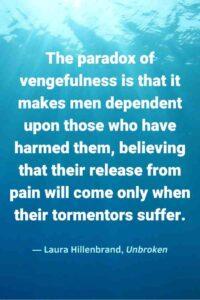
“The paradox of vengefulness is that it makes men dependent upon those who have harmed them, believing that their release from pain will come only when they make their tormentors suffer. In seeking the Bird’s death to free himself, Louie had chained himself, once again, to his tyrant.”
(Narrator: Laura Hillenbrand, Chapter 37, Page 373)
TL;DR: Retaining a desire for revenge creates a psychological feedback loop that keeps the survivor physiologically chained to their abuser.
Case 3.1: Trauma Bonding & Chronic Hyperarousal. This passage defines the clinical architecture of a trauma bond. By obsessing over Watanabe’s murder, Louis’s brain remains locked in a state of chronic hyperarousal, continuously activating stress pathways as if the torture were ongoing. This vengeance-fueled dependency prevents emotional resolution, ensuring that his nervous system remains hijacked by the very man he is trying to destroy.
“…resentment, the emotion that, Jean Améry would write, ‘nails every one of us onto the cross of his ruined past.’ ”
(Narrator: Laura Hillenbrand, Chapter 37, Page 374)
Hillenbrand utilizes the words of Holocaust survivor Jean Améry to explain the temporal paralysis caused by C-PTSD. Resentment is a neurological anchor, preventing the brain from processing trauma into long-term memory. Instead, it “nails” the survivor’s consciousness to the site of the original injury, forcing them to relive the past in a perpetual, agonizing present.
“Louie found himself thinking of the moment at which he had woken in the sinking hull of Green Hornet, the wires that had trapped him a moment earlier now, inexplicably, gone… When he turned these memories in his mind, the only explanation he could find was one in which the impossible was possible.”
(Narrator: Laura Hillenbrand, Chapter 38, Page 382)
This marks the crucial beginning of cognitive restructuring. Under the influence of Billy Graham’s sermon, Louis begins to actively re-examine his traumatic memories. By shifting his focal point from the horror of the crashes and beatings to the inexplicable moments of his survival, he initiates a process that alters the emotional valence attached to his trauma.
“What God asks of men, said Graham, is faith. His invisibility is the truest test of that faith. To know who sees him, God makes himself unseen.”
(Narrator: Laura Hillenbrand, Chapter 38, Page 382)
Graham’s theological concept provides Louis with a new cognitive schema to process his invisible psychological wounds. By reframing the concept of an “unseen” force from a source of unpredictable terror (like the war and the guards) to a source of divine, protective omniscience, Louis is offered a pathway to relinquish his hypervigilance.
“When he thought of his history, what resonated with him now was not all that he had suffered but the divine love that he believed had intervened to save him.”
(Narrator: Laura Hillenbrand, Chapter 38, Page 383)
TL;DR: Shifting the focus of a memory from the trauma endured to the survival achieved is a hallmark of post-traumatic growth.
Case 3.5: Memory Reconsolidation & Post-Traumatic Growth. Louis successfully executes a massive psychological intervention known as memory reconsolidation. He doesn’t erase his history; instead, he completely rewrites the emotional meaning of those memories. By extracting the narrative of “divine love” from a history of torture, he strips the traumatic memories of their power to trigger his autonomic stress response, fundamentally healing his moral injury.
“In a single, silent moment, his rage, his fear, his humiliation and helplessness, had fallen away. That morning, he believed, he was a new creation. Softly, he wept.”
(Narrator: Laura Hillenbrand, Chapter 38, Page 383)
TL;DR: The sudden physiological release of trauma marks the down-regulation of a chronically hyperactive amygdala.
Case 3.3: Neuroplastic Reset & Affective Release. This profound religious awakening is a literal neuroplastic reset for Zamperini’s brain. The immediate shedding of “rage, fear, humiliation, and helplessness” indicates a rapid, massive down-regulation of his amygdala, which had been locked in fight-or-flight mode for years. The physical act of weeping signifies the restoration of healthy emotional processing and the end of his trauma-induced somatic dissociation.
“At that moment, something shifted sweetly inside him. It was forgiveness, beautiful and effortless and complete. For Louie Zamperini, the war was over.”
(Narrator: Laura Hillenbrand, Chapter 39, Page 386)
Radical forgiveness operates as the ultimate cognitive severance from his abuser. By forgiving the Bird, Louis permanently cuts the psychological tether of his trauma bond. The war finally ends for Louis with the internal, neurological dismantling of his resentment, long after the signing of a peace treaty.
“When Louie was in his sixties, he was still climbing Cahuenga Peak every week and running a mile in under six minutes.”
(Narrator: Laura Hillenbrand, Epilogue, Page 391)
Hillenbrand includes this detail to demonstrate the deep connection between psychological healing and physical restoration. Once the toxic, immune-suppressing effects of chronic C-PTSD and alcoholism were removed by his cognitive reset, Louis’s body reclaimed the extraordinary physical vitality that had defined his youth.
“His conviction that everything happened for a reason, and would come to good, gave him laughing equanimity even in hard times.”
(Narrator: Laura Hillenbrand, Epilogue, Page 392)
This confirms that his neuroplastic recovery was permanent. The “laughing equanimity” he displays in his later years proves that his pre-war, innate resilience, the optimistic “wiring” that sustained him on the raft, was fully restored once the psychological infection of the POW camps was cured.
“His body was worn and weathered, his skin scratched with lines mapping the miles of his life.”
(Narrator: Laura Hillenbrand, Epilogue, Page 405)
This visual description acknowledges the permanent, physical toll of his survival. The “lines mapping the miles” treat his physical scars not as marks of degradation, but as a hard-earned geographical map of an unimaginably vast and arduous human journey.
“His old riot of black hair was now a translucent scrim of white, but his blue eyes still threw sparks.”
(Narrator: Laura Hillenbrand, Epilogue, Page 405)
While his body shows the inevitable decay of age and hardship, the “sparks” in his blue eyes are the final, triumphant diagnostic marker. It’s literary proof that the core psychological identity Mutsuhiro Watanabe tried so desperately to erase remained entirely intact, vibrant, and unbroken.
“I’ll be an easier subject than Seabiscuit, because I can talk.”
(Speaker: Louis Zamperini, Acknowledgments, Page 409)
This final, humorous quote spoken directly to the author showcases Zamperini’s retained agency and sharp wit. After a journey defined by silencing, starvation, and attempts to strip his humanity, his ability to confidently articulate his own story with humor is the ultimate victory.
“Finally, I wish to remember the millions of Allied servicemen and prisoners of war who lived the story of the Second World War… It is to them that this book is dedicated,”
(Speaker: Laura Hillenbrand, Acknowledgments, Page 416)
Hillenbrand’s concluding dedication expertly pans the camera back from a micro-clinical study of one man to the macro-tragedy of a global generation. She ensures that Louis’s singular narrative of extreme trauma and extraordinary resilience is a proxy to honor the collective suffering and sacrifice of millions who endured the crucible of World War II.
The Neuroplasticity of Redemption: Un-becoming a Prisoner
Laura Hillenbrand’s Unbroken is far more than a historical recount of World War II survival; it’s a clinical testament to the absolute limits of human neurobiology.
The quotes curated in this guide demonstrate that Louis Zamperini’s survival was a triumph of the human spirit and a biological achievement, driven by specific cognitive strategies such as active anchoring and delayed gratification.
Furthermore, his harrowing time in the Japanese POW camps reveals a grim physiological truth: dignity is a biological necessity, not a moral luxury. The systemic dehumanization orchestrated by his captors was a lethal hazard designed to induce learned helplessness and accelerate physical decay. Yet, Zamperini’s stubborn preservation of his internal identity is a literal life-support system against active erasure.
The story’s most profound miracle occurs long after the war has ended. Zamperini’s journey from severe C-PTSD and trauma bonding to a profound religious awakening is a masterclass in the neuroplasticity of redemption. By choosing radical forgiveness, he broke the psychological feedback loop that kept him chained to his abuser, actively re-wiring his traumatized brain.
His legacy proves that the human mind possesses the extraordinary capacity to heal itself, allowing a man who was utterly shattered to remain, in the end, unbroken.
To explore more incredible tales of survival, history, and the human spirit, visit our main collection and Explore More Literary Quote Collections.
A Note on Page Numbers & Edition:
Just as a life raft drifts on the currents of the Pacific, page numbers can vary across different printings and editions. The quotes and analysis above have been meticulously mapped to Unbroken: A World War II Story of Survival, Resilience, and Redemption (Random House Trade Paperbacks, July 29, 2014, ISBN-13: 978-0812974492). Please verify against your personal copy to ensure flawless citations for your academic essays and historical research.
Jeremy, founder of Ageless Investing, has spent over six years proving that analyzing classic literature is the ultimate investment in human wisdom and long-term intellectual capital. Applying a rigorous, hands-on framework specializing in primary-source textual audits and exact-quote analysis, he bridges historical resilience and modern decision-making. His guides provide strict structural blueprints to help human creators protect and defend their original work. Review Jeremy’s background, editorial standards, and manual verification process on his Author Bio Page.